The press kit musicians actually send
A promoter opens forty emails a day. Yours has a 40MB zip attached called
EPK_FINAL_v3.zip. They do not download it. That is the whole problem with the
traditional electronic press kit: the format makes the recipient do work before they know
whether you are worth the work.
A link they can open on their phone between soundchecks beats a folder every time.
What they are actually checking
A booker and a journalist want different things, but both decide fast. In rough order:
- Does this fit the room / the section? One line, near the top. Genre, city, a reference point.
- What does it sound like? Not a download. A player they can hit immediately.
- Is anyone else paying attention? Numbers, press, notable support slots.
- What will this look like on a poster? A photo at usable resolution.
- How do I reach the person who can say yes? One contact, not a phone tree.
If those five are answered in the first screen, you are in a much smaller pile.
The one-line pitch goes first
Not your biography. A sentence someone can repeat to a colleague.
Brooklyn-based producer making dance music for people who do not go out. Supported Jamie xx at Elsewhere, 40k monthly listeners.
City, sound, proof. That is it. Save the origin story for your website.
Music they can hear in one tap
Embed it. A player that starts on the page removes the single biggest drop-off point in the whole process. Two or three tracks, best first — not your entire discography in chronological order.
If you only have one thing to show, show one thing. A short, strong page beats a padded one.
Photos that are actually usable
Two or three, high resolution, and at least one where your face is unobstructed and the background is simple enough to crop. Promoters need to put you on a poster at a size and shape you did not anticipate.
Name the files something human. astrid-lowe-press-1.jpg is findable six weeks later;
IMG_4471.jpg is not.
Proof, stated plainly
Achievements, press quotes, playlist adds, support slots, monthly listeners. Real numbers beat adjectives, and a small real number beats a vague large claim. "800 people at Trans Pecos" is more persuasive than "rapidly growing fanbase."
If a journalist wrote something good, quote one sentence and link the piece.
Tour dates, if you have them
Upcoming shows tell a promoter you are active and tell a journalist there is a peg for a story. Keep past dates visible too — a routing history is evidence you can fill rooms outside your own city.
Contact, once
One email address, the one that is actually monitored. If you have management, say who handles what. Every extra hop is a chance for the reply to not happen.
Why this lives on a link
Three practical reasons:
- It opens on a phone, which is where it will be opened.
- You can change it after you send it. New single, new photo, new number — the link the promoter saved in March still works in June.
- You can see whether it was read. Attachments tell you nothing. A page tells you it was opened and what got clicked, which is genuinely useful information before a follow-up email.
Keep it to one screen of decisions
The failure mode is comprehensiveness. Every extra section pushes the contact detail further down. Pitch, music, photo, proof, dates, contact — then stop.
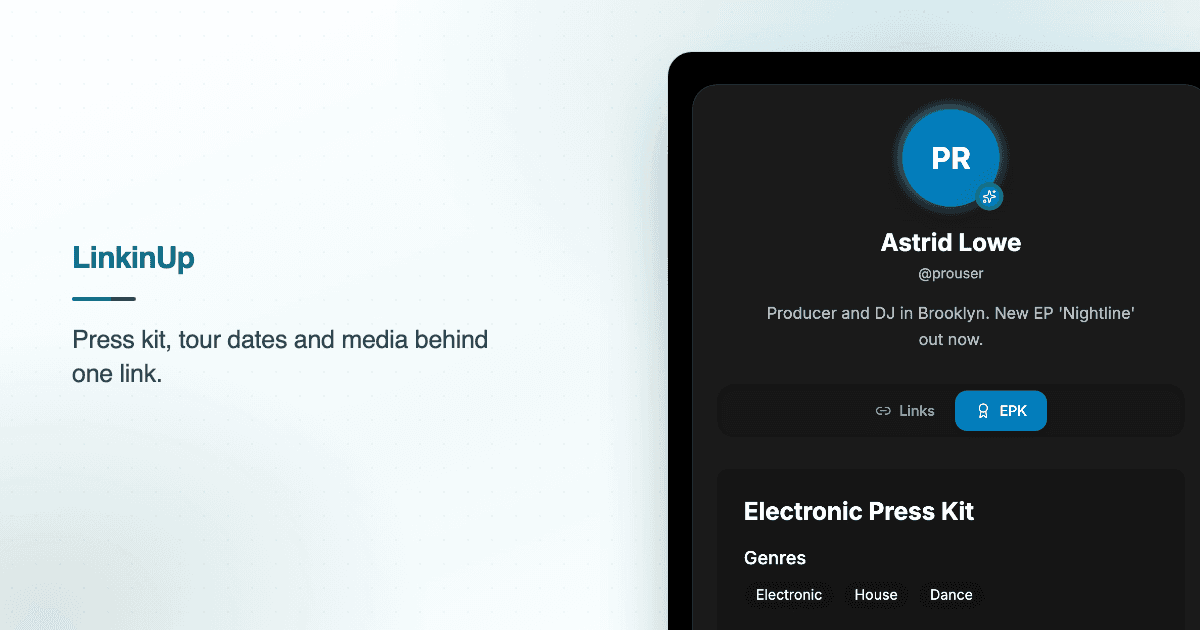
LinkinUp's EPK is built for exactly this: media embeds, photo sets, achievements, press and tour dates on one page at your own URL, alongside the rest of your links. It is included on the Invite and Pro tiers.
If you are still deciding which tool to use, we wrote an honest comparison including where we are not the right answer. And if your links page is doing the pitching for now, make sure it is doing it well.
Build your press kit — free to start.